
Service explanation for JA-110ST
Wired fire detector
This wired detector is part of the JABLOTRON JA-100 alarm system. The sensor detects fire hazard indoors. It is not intended for installation in an industrial environment. The detector consists of an optical smoke detector and a temperature sensor. The optical smoke detector is very sensitive to larger particles that occur in dense smoke, less sensitive to small particles that arise from burning liquids, such as alcohol. That is why a temperature sensor has also been built in, which has a slower response, but is capable of detecting a fire with a small amount of smoke. The detector responds to the condition and reports it to the control panel. The product is intended for installation by a trained technician with a valid Jablotron certificate.
Place detector
Smoke enters the detector through the flowing air - therefore it must be installed in a place where the air flows well due to natural thermal circulation (usually towards the ceiling). The detector can only be used in a closed interior. It is not suitable where smoke can spread and cool (e.g. high ceilings - more than 5 m) - smoke will then not reach the detector.
In flats, the detector must always be installed in the area leading to the exit (escape route) see Figure 1. If the floor area in the flat exceeds 150 m2, another detector must be installed there, in another part of the house, see Figure 2.
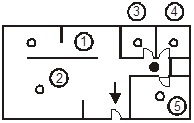
image 1
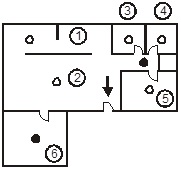
image 2
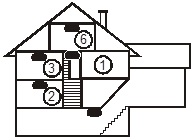
image 3
It is recommended to install a detector in every room where people sleep.
Place under flat ceilings
If possible, install the detector in the center of the room. Since a cold layer can form near the ceiling, the detectors must not be sunk into the ceiling. The fire detector must never be installed in a corner of the room (maintain a distance of at least 0.5 m from the corner of the room, see Figure 4). Air circulates poorly in the corners.
Place under sloping ceilings
If the ceiling does not have a suitable straight surface (e.g. an attic room), the detector can be positioned as shown in Figure 5.
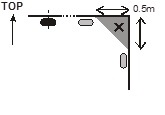
image 4
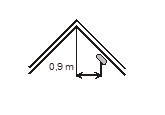
image 5
the center of the room, the best place, a possible place
Walls, partitions, obstacles, ceilings with bare beams
The detector must be installed at least 0.5 m from a wall or obstacle. If the room is narrower than 1.2 m, the detector should be installed within the middle third of its width. If the room is divided into sections by means of furniture, shelves or half-partitions, above which there is no more than 0.3 m distance from the ceiling, the individual sections should be considered as separate rooms. There must be a free space of at least 0.5 m in all directions under and around the detector. Any irregularities in the ceiling (such as a beam), with dimensions greater than 5% of the ceiling height, are considered walls and all of the above remains in force.
Ventilation and air movement
Detectors may not be located directly at the outlet of ventilation, air conditioning, etc. are installed. If air is introduced through a perforated ceiling, the ceiling must be unperforated for 0.6 m in all directions around the detector.
Do not place detector:
? Where air flows poorly (niches, corners, ceiling ridges on A-roofs, etc.)
? where it is dusty, smoked or where steam occurs
? in places where air flows intensively (close to fans, heat sources, ventilation outlets, draft holes, etc.)
? in kitchens and damp areas (steam, smoke and greasy vapor can cause false alarms or detection failure)
? next to fluorescent or energy saving lamps (electrical interference can cause a false alarm)
? in places with large quantities of small insects
Attention: Most often the detector becomes unwantedly active due to an incorrect installation location.
More detailed installation instructions can be found in CSN TS 54-14.
Installation
When installing, follow the advice in the previous paragraphs.
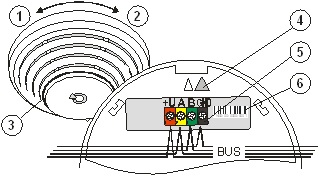
Figure 6: 1 – detach (remove) detector; 2 – secure (set up) detector; 3 – optical signaling; 4 – orientation arrow for setting up; 5 – bus terminals; 6 – serial number
1. Open the detector cover by turning it counterclockwise (1).
2. Pull the bus cable through and screw the plastic back panel into place at the chosen location.
3. Connect the bus cable.
Before connecting the BUS, the system must be disconnected from the power supply.
4. Follow the installation manual of the control panel. Basic steps:
a. After switching on, the yellow signal light flashes because the detector is not included in the system.
b. In the F-Link program, select the desired position on the Peripherals card and start the learning mode with the Read button.
c. Place the detector on the plastic back wall. It can only be done in one position, indicated by arrows (4) on both plastic parts. Confirm by turning. This causes the tamper sensor to come into contact inside and the detector learns. The yellow signal light (3) will go out.
Set detector properties
This is done by the F-Link program – card Peripherals. Select internal settings at the detector position. A dialog will appear in which you can set:
LED indication on: the red LED signaling activation can be turned off.
Method of detection – smoke only, temperature only, smoke and temperature simultaneously, smoke or temperature.
Test and maintain detector
Operation of the detector can be checked with a test spray. The legislation recommends testing the detector once every 30 days. The detector must be regularly cleaned of dust, cobwebs and the like. be stripped.
Please note: Never use the detector test the lighting of an open fire in the object.
Indication of fault
The detector automatically checks its own operation. As soon as a fault is detected, the yellow control light lights up. In that case, remove the batteries for 1 minute and put them back in. If the light comes on permanently again after approximately 1 minute, take the detector to the service department.
Technical parameters
Power supply from the central BUS 12 V (9…15 V)
Power consumption in standby (rest) 5 mA
Power consumption for choice of cable 10 mA
Dimensions: diameter 126 mm, height 50 mm
smoke detection optical light diffusion
smoke detector sensitivity m = 0.11 ¸ 0.13 dB/m cf. CSN EN 54-7
temperature detection class A2 in accordance with CSN EN 54-5
alarm temperature 60°C to 70°C
working temperature range -10°C to +80°C
Complies with CSN EN 54-5, CSN EN 54-7
further CSN EN 50130-4, CSN EN 55022
Place detector
Smoke enters the detector through the flowing air - therefore it must be installed in a place where the air flows well due to natural thermal circulation (usually towards the ceiling). The detector can only be used in a closed interior. It is not suitable where smoke can spread and cool (e.g. high ceilings - more than 5 m) - smoke will then not reach the detector.
In flats, the detector must always be installed in the area leading to the exit (escape route) see Figure 1. If the floor area in the flat exceeds 150 m2, another detector must be installed there, in another part of the house, see Figure 2.
image 1
image 2
image 3
It is recommended to install a detector in every room where people sleep.
Place under flat ceilings
If possible, install the detector in the center of the room. Since a cold layer can form near the ceiling, the detectors must not be sunk into the ceiling. The fire detector must never be installed in a corner of the room (maintain a distance of at least 0.5 m from the corner of the room, see Figure 4). Air circulates poorly in the corners.
Place under sloping ceilings
If the ceiling does not have a suitable straight surface (e.g. an attic room), the detector can be positioned as shown in Figure 5.
image 4
image 5
the center of the room, the best place, a possible place
Walls, partitions, obstacles, ceilings with bare beams
The detector must be installed at least 0.5 m from a wall or obstacle. If the room is narrower than 1.2 m, the detector should be installed within the middle third of its width. If the room is divided into sections by means of furniture, shelves or half-partitions, above which there is no more than 0.3 m distance from the ceiling, the individual sections should be considered as separate rooms. There must be a free space of at least 0.5 m in all directions under and around the detector. Any irregularities in the ceiling (such as a beam), with dimensions greater than 5% of the ceiling height, are considered walls and all of the above remains in force.
Ventilation and air movement
Detectors may not be located directly at the outlet of ventilation, air conditioning, etc. are installed. If air is introduced through a perforated ceiling, the ceiling must be unperforated for 0.6 m in all directions around the detector.
Do not place detector:
? Where air flows poorly (niches, corners, ceiling ridges on A-roofs, etc.)
? where it is dusty, smoked or where steam occurs
? in places where air flows intensively (close to fans, heat sources, ventilation outlets, draft holes, etc.)
? in kitchens and damp areas (steam, smoke and greasy vapor can cause false alarms or detection failure)
? next to fluorescent or energy saving lamps (electrical interference can cause a false alarm)
? in places with large quantities of small insects
Attention: Most often the detector becomes unwantedly active due to an incorrect installation location.
More detailed installation instructions can be found in CSN TS 54-14.
Installation
When installing, follow the advice in the previous paragraphs.
Figure 6: 1 – detach (remove) detector; 2 – secure (set up) detector; 3 – optical signaling; 4 – orientation arrow for setting up; 5 – bus terminals; 6 – serial number
1. Open the detector cover by turning it counterclockwise (1).
2. Pull the bus cable through and screw the plastic back panel into place at the chosen location.
3. Connect the bus cable.
Before connecting the BUS, the system must be disconnected from the power supply.
4. Follow the installation manual of the control panel. Basic steps:
a. After switching on, the yellow signal light flashes because the detector is not included in the system.
b. In the F-Link program, select the desired position on the Peripherals card and start the learning mode with the Read button.
c. Place the detector on the plastic back wall. It can only be done in one position, indicated by arrows (4) on both plastic parts. Confirm by turning. This causes the tamper sensor to come into contact inside and the detector learns. The yellow signal light (3) will go out.
Set detector properties
This is done by the F-Link program – card Peripherals. Select internal settings at the detector position. A dialog will appear in which you can set:
LED indication on: the red LED signaling activation can be turned off.
Method of detection – smoke only, temperature only, smoke and temperature simultaneously, smoke or temperature.
Test and maintain detector
Operation of the detector can be checked with a test spray. The legislation recommends testing the detector once every 30 days. The detector must be regularly cleaned of dust, cobwebs and the like. be stripped.
Please note: Never use the detector test the lighting of an open fire in the object.
Indication of fault
The detector automatically checks its own operation. As soon as a fault is detected, the yellow control light lights up. In that case, remove the batteries for 1 minute and put them back in. If the light comes on permanently again after approximately 1 minute, take the detector to the service department.
Technical parameters
Power supply from the central BUS 12 V (9…15 V)
Power consumption in standby (rest) 5 mA
Power consumption for choice of cable 10 mA
Dimensions: diameter 126 mm, height 50 mm
smoke detection optical light diffusion
smoke detector sensitivity m = 0.11 ¸ 0.13 dB/m cf. CSN EN 54-7
temperature detection class A2 in accordance with CSN EN 54-5
alarm temperature 60°C to 70°C
working temperature range -10°C to +80°C
Complies with CSN EN 54-5, CSN EN 54-7
further CSN EN 50130-4, CSN EN 55022