
Service explanation for JA-182M
Wireless built-in magnetic contact
This product is part of the Jablotron 100 series alarm system. It ensures the detection of the opening of a window (door). The detector is installed in the plastic or wooden frames and can be used with the most common types of hinges and locks. The detector communicates wirelessly via the Jablotron protocol and is powered by batteries.
Installation of detector – basic information
The installation must be carried out by a trained technician with a valid Jablotron certificate. The detector must not be bent or otherwise deformed - risk of damage.
The product is installed in the gap between the moving and fixed frame (where the locking mechanism of the hinges and locks is).
In practice, there are different profiles of frames and different types of hinges and locks. It is therefore advisable to first check whether the detector fits in the type of window (or door) in question. If the profile of a wooden frame is narrower, a notch can usually be milled out for placing the detector.
The detector is placed on the fixed frame, the activation magnet on the movable frame. The detector responds to the increase in distance from the magnet when the window opens. If the supplied magnet does not correspond exactly to the window version, either a suitable type of magnet can be requested from the window supplier, or the supplied magnet can be adjusted by using a suitable washer, etc.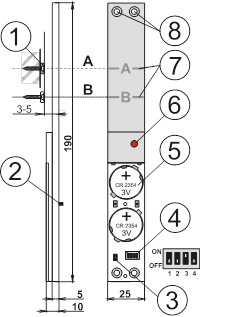
Image: 1. magnet; 2. rear tamper contacts; 3. tamper contact from the screen; 4. configuration switches; 5. battery; 6. LED signal light; 7. detection marks; 8.mounting holes
Assembly step by step
1. Find a suitable place to install the detector and magnet, so that after closing the window the magnet is above the A (or B) line. By opening the window, the magnet must be removed by at least 2 cm.
2. Ideally, a location in the moving frame of the window, where there are no hinges or locks (i.e. the detector should not be placed directly next to a metal). You will usually find such a place on the side between the hinges. Mounting the detector in the lower part of the window is not recommended due to possible water condensation.
3. Screw the magnet to the moving frame as shown in the picture. If the rebate in the window is wider than the plastic of the magnet, use a suitable non-metallic washer under the magnet.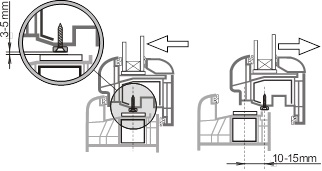
4. Remove the battery cover and mount the detector in such a way that when it closes the magnet is above the A or B line (see image). Tighten the screws of the detector carefully so as not to damage the plastic.
5. If the window frame or detector mounting location is not straight, place the long plastic shims provided under the detector. With the detector installed, at least one rear tamper sensor must remain permanently pressed.
6. Carefully check whether the window closes and whether the detector and magnet are not in the way.
7. If everything is OK, set the detector functions (see configuration switches)
8. Switch on learning mode in the central unit (receiver), then connect batteries to the detector and screw on the cap (2 screws). After connecting the batteries, the detector sends the learning signal. The detector will only respond to increasing/decreasing the distance of the magnet and pressing/releasing tamper sensors 10 seconds after closing the battery cover.
9. After the detector has learned, check its operation (also check the quality of the signal on the Jablotron central unit).
10. Signal light – indicates activation of the detector for 15 minutes after closing the battery cover (opening of the window with flashing, activation of both rear tamper sensors with long lighting).
Configuration switches
Under the battery cover there are 4 switches for setting the detector: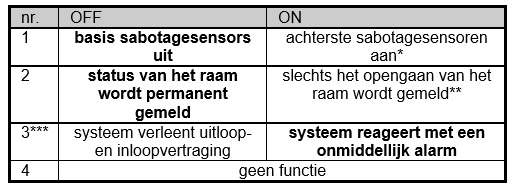
Detector operation
With switch no.2 in position OFF, the detector reports that the window is permanently open. When the system is armed with a window open, the control panel bypasses the detector. However, if someone closes the window during the arming and then opens it again (e.g. after moving the window button to the open position using a string), an alarm is triggered. If the keypad should not indicate that the window is permanently open, set the configuration switch no.2 to the ON position (only the opening of the window is reported).
Replace batteries in the detector
The system checks the battery status and as soon as they start to discharge, it informs the user (possibly also the service technician). The detector continues to work, but we recommend replacing the battery within 2 weeks. Always replace both batteries with new ones at the same time and only use high-quality brand batteries (e.g. Panasonic). After replacing the batteries, it is recommended to test the operation of the detector.
Do not dispose of used batteries with household waste, but dispose of them with chemical waste.
Remove detector from the system
The system reports any loss of the detector. If you deliberately dismantle the detector, you must also erase it from the control panel.
Technical parameters
Power supply Lithium battery type CR2354 - 2 pcs. (3.0V 1Ah),
Source type C
Typical battery life approx. 3 years (max. 5 activations/day)
Communication band 868.1 MHz, Jablotron protocol
Communication range approx. 200m (direct visibility)
Dimensions 192 x 25 x 9 mm
Environment according to EN 50131-1 II. inside, general
Working temperature range -10 to +40 °C
Classification grade 2
according to EN 50131-1,EN 50131-2-6, EN 50131-5-3
Furthermore complies with ETSI EN 300220, EN 50130-4,
EN 55022, EN 60950-1
JABLOTRON ALARMS a.s. hereby declares that the detector has been designed and manufactured in accordance with the provisions applicable to it: Government Decree No. 426/2000 Coll., in the text of subsequently promulgated regulations, provided that it is used according to its intended purpose.
Note: Although this product does not contain harmful materials, do not dispose of it in the household waste, but hand it in at the collection point intended for electronic waste.